Celebrating Nick Darke: His Life, Work and Legacy
Written by Danielle Hutchinson

Actor James Whear performing in the ‘Nick Darke: Life, Work, Legacy’ readings at AMATA, June 2025. Photo: Ciaran Doherty.
In June, a performance was held at AMATA to commemorate the 20th anniversary of the death of legendary Cornish playwright, Nick Darke.
The ‘Nick Darke: Life, Work, Legacy’ performance was compiled entirely of extracts from his notebooks and manuscripts, which are housed in a dedicated archive on Penryn Campus.
Acting students, Lydia Clark, Sinead Ferguson, Daisy-Belle Tardrew and James Whear, said it was an honour to perform the world premiere of these pieces.
“It’s about honouring Nick Darke and there was such a respectful atmosphere, but also everyone just seemed to really enjoy the evening.”
“For us to go from such comedic, funny stories, such as the weaver fish, to something as heartfelt and emotional as the wife and husband scene – I think that really highlights the breadth of his work and how brilliant he was as a playwright.”
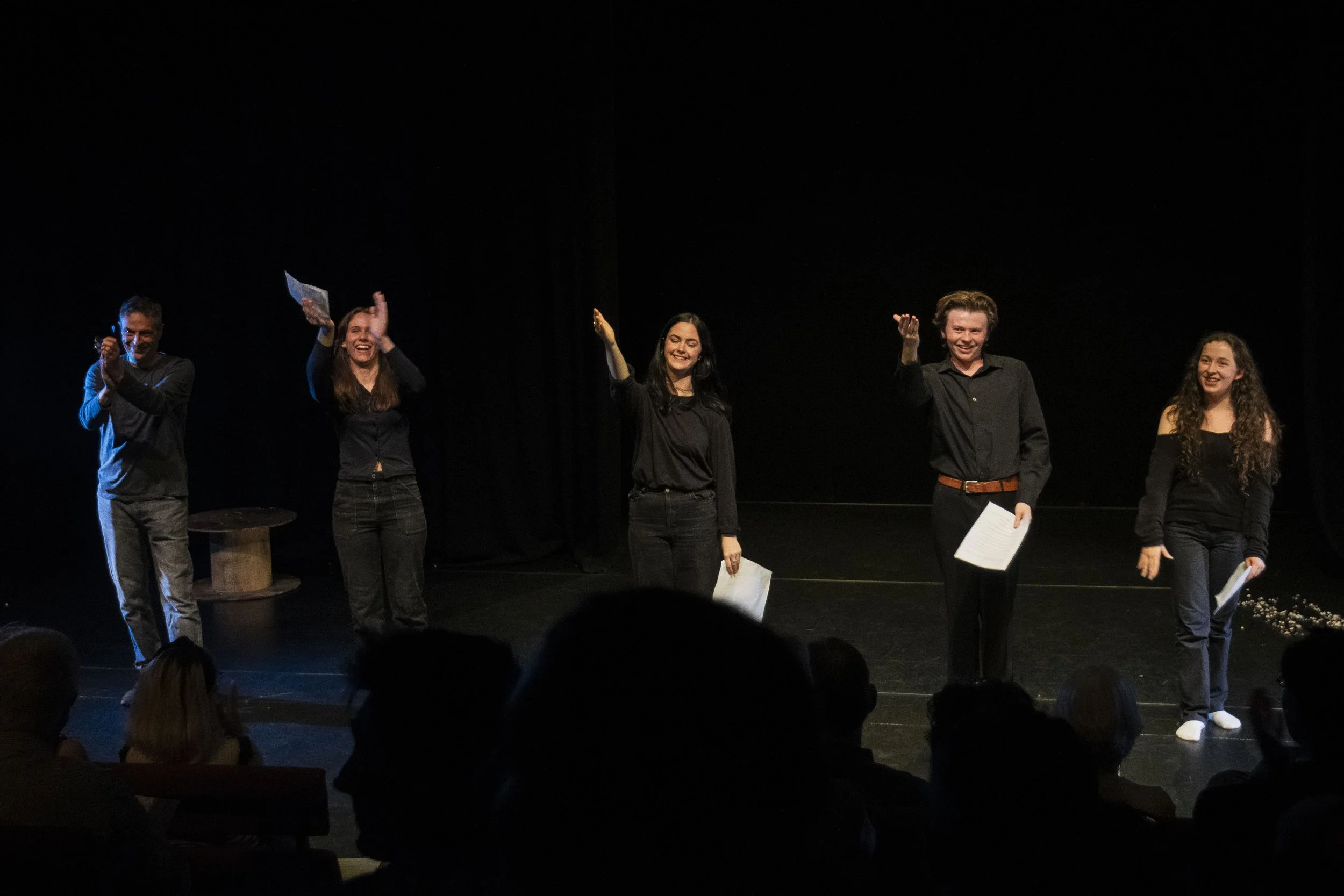
Acting students taking their bows at the end of the ‘Nick Darke: Life, Work, Legacy’ performance, alongside Head of Theatre Arts Trevor Rawlins. Photo: Ciaran Doherty.
The performance was not only a product of the acting students’ work, but also a collaboration with third-year writing students, Verity Borras, Darcy Duncan, Lottie Razzino and Hilary Thain, who spent time researching in the Nick Darke Archives and curating the extracts.
Director Nicola Coplin, who teaches on the BA Creative Writing courses, said the archive notebooks gave a brilliant insight into the process of writing.
“We took some of our third-year writing students who are particularly interested in scriptwriting into the archives to just see what we could find.”
“We were really quite in awe of what we were reading and the fun bit was seeing some profound statement followed by ‘got to pick up wallpaper paste’ or something – it felt like seeing into a writer’s life.”
This inspired the performance of ‘A Conversation Between Nick’s Notebooks’ where the actors created a dialogue between the various pages of the notebooks, ranging from story ideas to shopping lists and recipes.
As writing becomes more digitised and old drafts are simply deleted, it’s increasingly rare to find such a full record of the writing process, from initial notes to final manuscripts.
His wife Jane Darke, who donated the archive to the university, said that when you look at the archive you can see exactly where Nick’s work came from.
“It’s wonderful to see it being used and understood in the value that it has… you’ve got every part of the process from beginning to end.”
“Some of what you’ll hear are pieces of writing that maybe never went much further, but instigated a whole other chain of thought that led into a play.”
Extracts performed included previously unnamed scripts ‘The Weaver Fish’ and ‘The Two Artists’, as well as the ‘Nicaraguan Diaries’, which went on to form the basis of Darke’s 1989 play ‘Kissing the Pope’ for the Royal Shakespeare Company.
The acting students were thrilled to be able to delve into the pieces and explore the potential ways they could perform them on stage.
“It was such a surreal experience to be able to bring these words that have never been performed before to life. That’s not something you get to say that you’ve done very often.”
“We’re graduates; this is our last performance in this building and it’s a culmination of the three years of studying. What an amazing thing to end it on.”
“The magic is all in the work – as actors, we’re just translating it to the audience.”
The actors were pleased that the performance was well-received by the audience, and especially by Jane Darke.
“We’re really moved that Nick’s wife Jane was also moved by this evening, which was very, very important to us.”
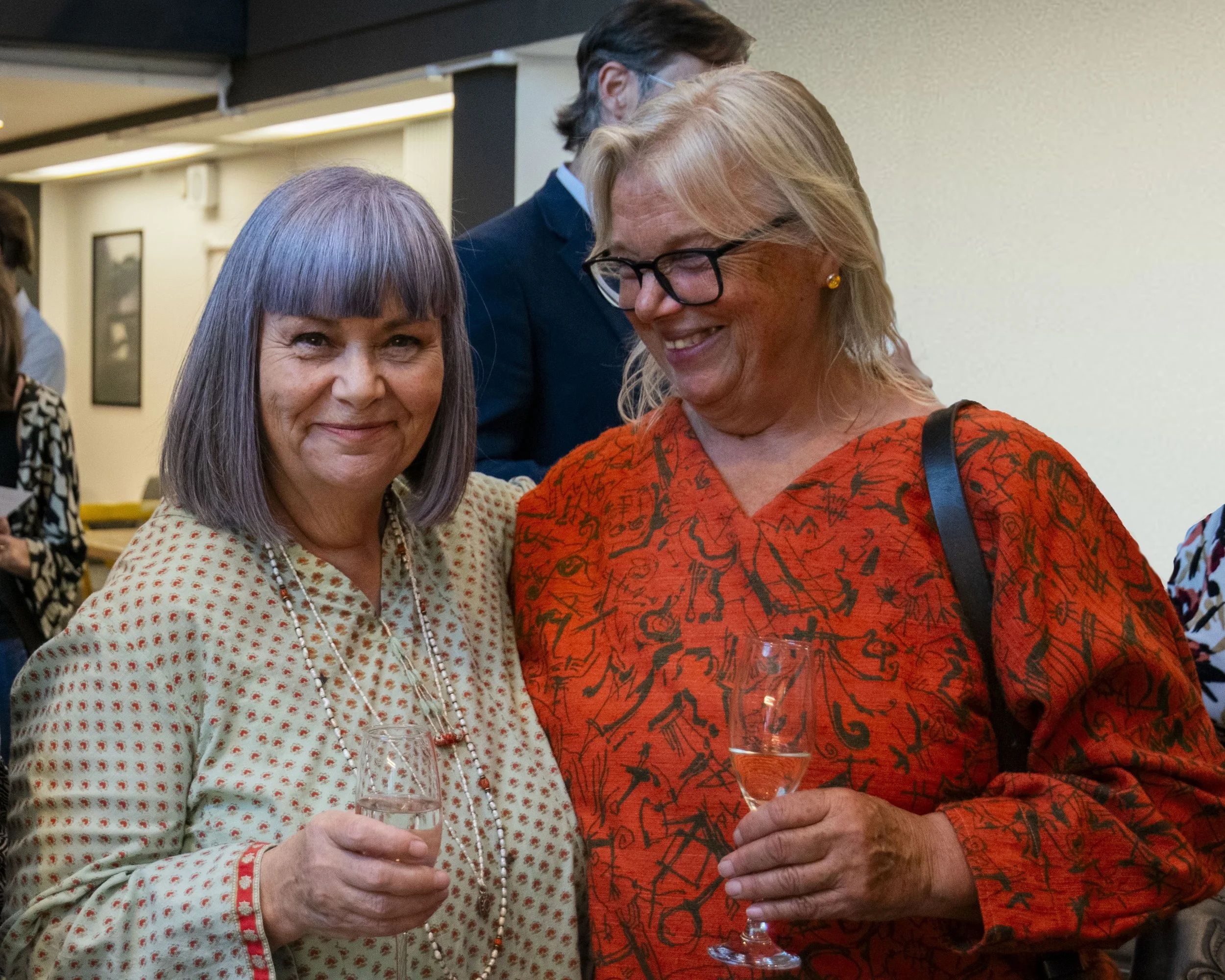
Chancellor Dawn French and Jane Darke at the ‘Nick Darke: Life, Work, Legacy’ event at AMATA, June 2025. Photo: Ciaran Doherty, edited by Danielle Hutchinson.
It wasn’t just Jane who was impressed by the actors. Also in attendance was Chancellor Dawn French, who congratulated the actors on their performances.
Head of Theatre Arts at AMATA Trevor Rawlins said that it was a great bit of experience for the students.
“They’ve had a taste of doing a job really, of working with Nicola who’s a writer and director.”
Actor Sinead said this is just one of many opportunities that studying at Falmouth has presented.
“I genuinely could not have chosen a better place for me and my career – the opportunities I’ve had in Falmouth, I wouldn’t have found anywhere else and it’s just been incredible to reflect and show all of my training up until this point for this performance.”
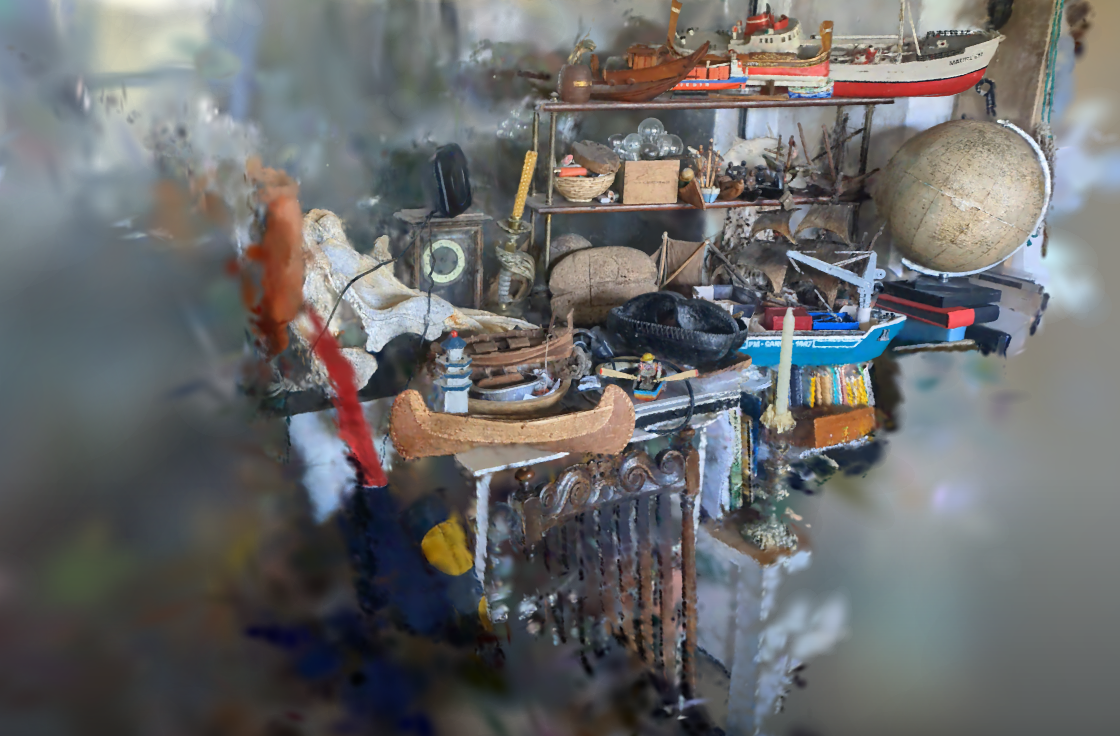
A 3D image of Nick Darke’s writing room, created using ‘Gaussian splatting’. Image courtesy of the Centre for Blended Realities, Falmouth University.
As well as being performed on stage, the Nick Darke archive is being reimagined at the university using virtual reality technology.
Head of the Centre for Blended Realities Lee Miller attended the Nick Darke event to showcase 3D imagery of Nick Darke’s writing room.
“There is the archive of written work which we saw so beautifully performed, but there is also this space which provides a contextual richness to his work.”
The team captured the writing room using a technique called ‘Gaussian splatting’ which involves taking a range of photographs from different angles and creating a 3D digital version of the scene.
“I think the careful use of digital curation is an incredibly vibrant and vital part of exploring how the archive moves forwards.”
Vice-Chancellor Emma Hunt said that Nick Darke laid the foundation for future Cornish creatives and the university hopes to build upon his legacy.
“Nick's plays, rooted in Cornish life, helped put the Duchy on the cultural map, becoming, as they did, nationally and internationally acclaimed.”
“We’re proud to be custodians of this important cultural asset and honoured to share it with our community.”
Jane Darke reflected on the decision to have the archives at Falmouth University.
“Nick was on the cultural task force when the university was being planned and I think he would be delighted; he would be so pleased by what it has become and it was absolutely the right place for his archive to be.”
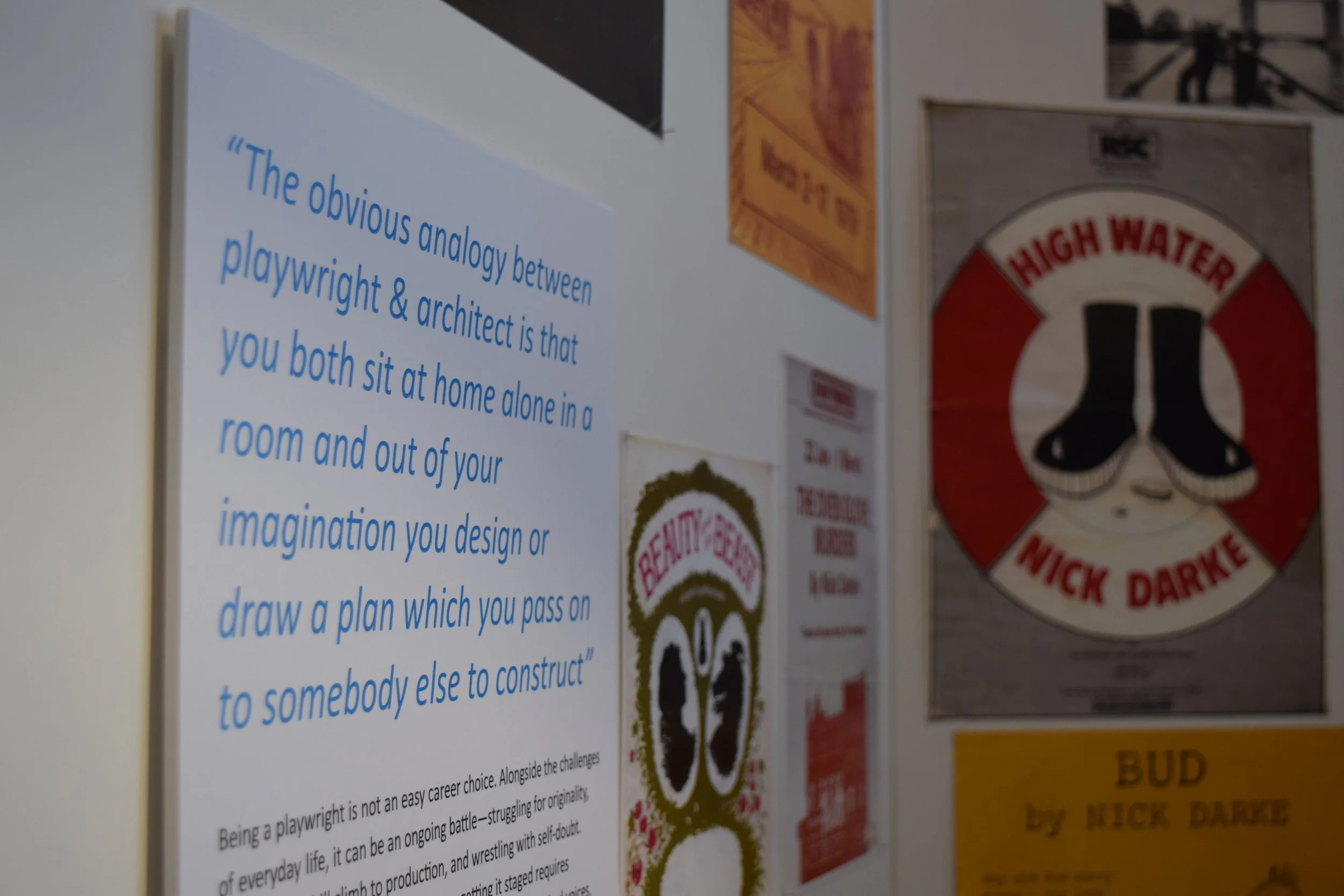
One of the displays in the Nick Darke Archive exhibition on Penryn Campus, commemorating the 20th anniversary of the playwright’s death in 2005. Photo: Danielle Hutchinson.
The archive team have curated an exhibition to mark the 20th anniversary, selecting pieces from the Nick Darke collection to display in Penryn Campus Library.
“We wanted to bring Nick’s voice into the exhibition, so all the text opens with quotes from him about his life and his work.”
There are over 1,000 pieces currently catalogued in the Nick Darke collection.
When it was donated to Falmouth University in 2009, it was one of the founding collections of a dedicated archive service, which now houses over 40 collections.
The archivists encourage students, staff, and members of the public to engage with the collections and explore what they have to offer.
“We’re really passionate about making archives more accessible to everyone.”
This includes running projects such as ‘Making: Archives’ and an annual artist residency where students from any course can create a project inspired by pieces in the archives.
“We have applications from students across a diverse range of courses - it doesn’t have to be that the archive directly relates to their creative discipline - some of the best projects we’ve had is when students use the archives to explore something totally different.”
“The Nick Darke archive is so valuable for students to see the process that goes into creating a piece of work, not just the finished script or performance.”
Alongside items from the archive, the exhibition in Penryn Campus Library is screening the trailer for the Nick Darke documentary ‘Atlas Pool’ by Jane Darke and Andrew Tebbs.
The film features testimonials from Nick Darke’s former colleagues which sum up the essence of his archive.
“While I was with Nick, the adage that all writing is autobiographical is true. That is to say that the person and the work are always indivisible.”
“His writing was honest, humane, imaginative, funny, stubborn, and full of a wilful determination to leave the world a better place than he found it.”
Enquiries can also be made to see the archive itself by emailing archives@fxplus.ac.uk or calling 01326 255738.
Article by Danielle Hutchinson.
Photographs by Ciaran Doherty, Danielle Hutchinson, and the Centre for Blended Realities.
The trailer for ‘Atlas Pool’ by Jane Darke and Andrew Tebbs can be viewed here: https://www.janedarke.co.uk/boatshed-films-ltd/